


|
History |
 |
Vietnam Museum of Ethnology is both a
research centre and a public museum exhibiting the ethnic groups
of Vietnam. The mission of the Museum is scientific research,
collection, documentation, conservation, exhibition and
preserving the cultural and historic patrimony of the nation’s
different ethnic groups. The museum also serves to guide
research, conservation, and technology that are specific to the
work of an ethnographic museum.
In its planning for the future, the Museum intends to present
the cultures and civilisations of other countries of South-East
Asia as well as in the region.
v
Establishment
Vietnam is a
multi-ethnic country, which is composed of 54 ethnic groups.
Perceiving the importance of having an ethnographic museum to
preserve and present the cultural heritages of ethnic groups,
the Government decided to establish a museum of ethnology in
Hanoi. The Proposal for the Vietnam Museum of Ethnology was
officially approved on December 14, 1987. Land was allocated for
construction: in 1987, 2,500m2 and in 1988, 9,500m2. Then, in
1990, the Prime Minister decided to allocate the entire 3,27
acres of land to the Museum.
During construction (1987 to 1995), the Project Managing Board
and the Museum Department were a part of the Institute of
Ethnology. On October 24, 1995, the Prime Minister made the
decision on establishment of the Vietnam Museum of Ethnology,
under National Centre for Social Sciences and Humanities. On
November 12, 1997, the Vietnam Museum of Ethnology inaugurated
its permanent exhibition and officially opened to the public.
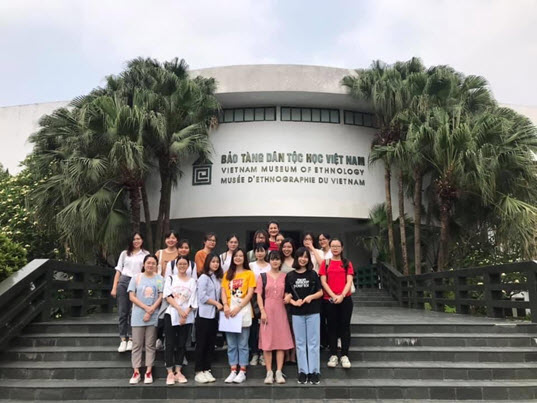
The Museum is located
in a large open area on Nguyen Van Huyen Street, Cau Giay
District, about 8 km from the city centre. This area used to be
paddy field of the local people. During the construction of the
Museum, all of the infrastructure was built, including the 700m
road from Hoang Quoc Viet Street to the entrance of the Museum.
(In the near future, this road will reach the Daewoo Hotel,
which is situated between Cau Giay and Lieu Giai Streets)
The Vietnamese Government first invested in the Museum in 1986
and construction of the foundation began in late 1989. According
to the proposal, the total budget for construction was 27
billion of Vietnamese dong (US$ 1.9 million), not including 4
billion dong (US$ 285,000) for collecting and exhibiting the
artefacts.
The exhibition building of the Museum was designed by the
architect Ha Duc Linh, a Tay minority, who works for the Living
Houses and Public Works Building Company, Ministry of
Construction. The interior architecture was done by Mrs.
Veronique Dollfus, a French architect.
The Museum is divided into two parts: an indoor and an outdoor
exhibition. The indoor part is composed of the exhibition
building, office, research centre, library, storage, technical
lab and auditorium. These offices cover 2,480m2, including 750
m2 for storage of artefacts. The outdoor exhibition, which will
be accomplished in the first years of the 21st century, is to
highlight different types of houses in all parts of Vietnam.
Pathways link the indoor and outdoor exhibitions with each
other.
Since its inauguration on the occasion of the 7th Summit of
Francophony in Hanoi, give date the Museum receives about 60,000
visitors annually.

v
What is new at the Vietnam Museum of Ethnology?
The Vietnam Museum of
Ethnology is a valuable centre for the exhibition and the
preservation of cultural heritages of the 54 ethnic groups in
Vietnam. To date, the Museum has collected 15,000 artefacts,
2,190 slides, 42,000 photographs, 237 audiotapes, 373 videotapes
and 25 CD-ROMs. It is also a centre for ethnographic research
employing many experts on the different ethnic groups. People
come to the Museum just not to visit or entertain, but also to
learn about these ethnic groups, their cultural diversity and
the uniqueness of each group and region, as well as traditional
values throughout the Vietnamese country. For this reason,
national and international visitors, children and students,
professionals and non-professionals are attracted to the Museum.
The artefacts of the
Museum are not only priceless antiquities, but many are everyday
objects, such as knives, baskets, garments, flutes, pipes and
mats. These objects reflect tangible and intangible cultural
heritages of the communities, representing lives and creative
activities of the people. Thus, artefacts of the Museum are so
varied that they are organised into different collections. The
Museum has 54 collections of each individual ethnic group.
Functionally classified, there are collections of clothing,
jewellery, of agricultural tools, fishing instruments, weapons,
household utensils and musical instruments. In addition, there
are collections of artefacts related to the various religions,
beliefs, wedding ceremonies, funeral ceremonies and other social
and spiritual activities. Based on the specific collections, the
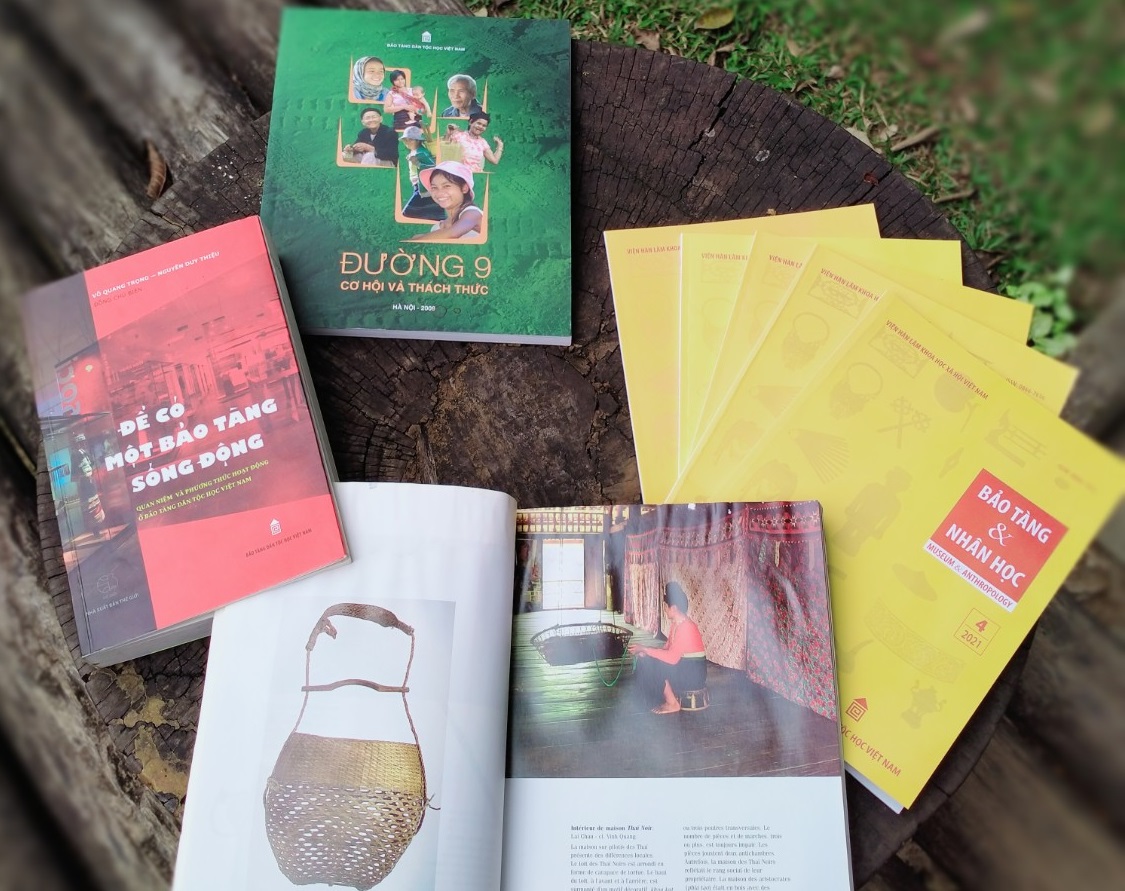
Museum organises exhibitions and publishes books and catalogues
in different formats in order to meet the needs of various
audiences of different backgrounds.
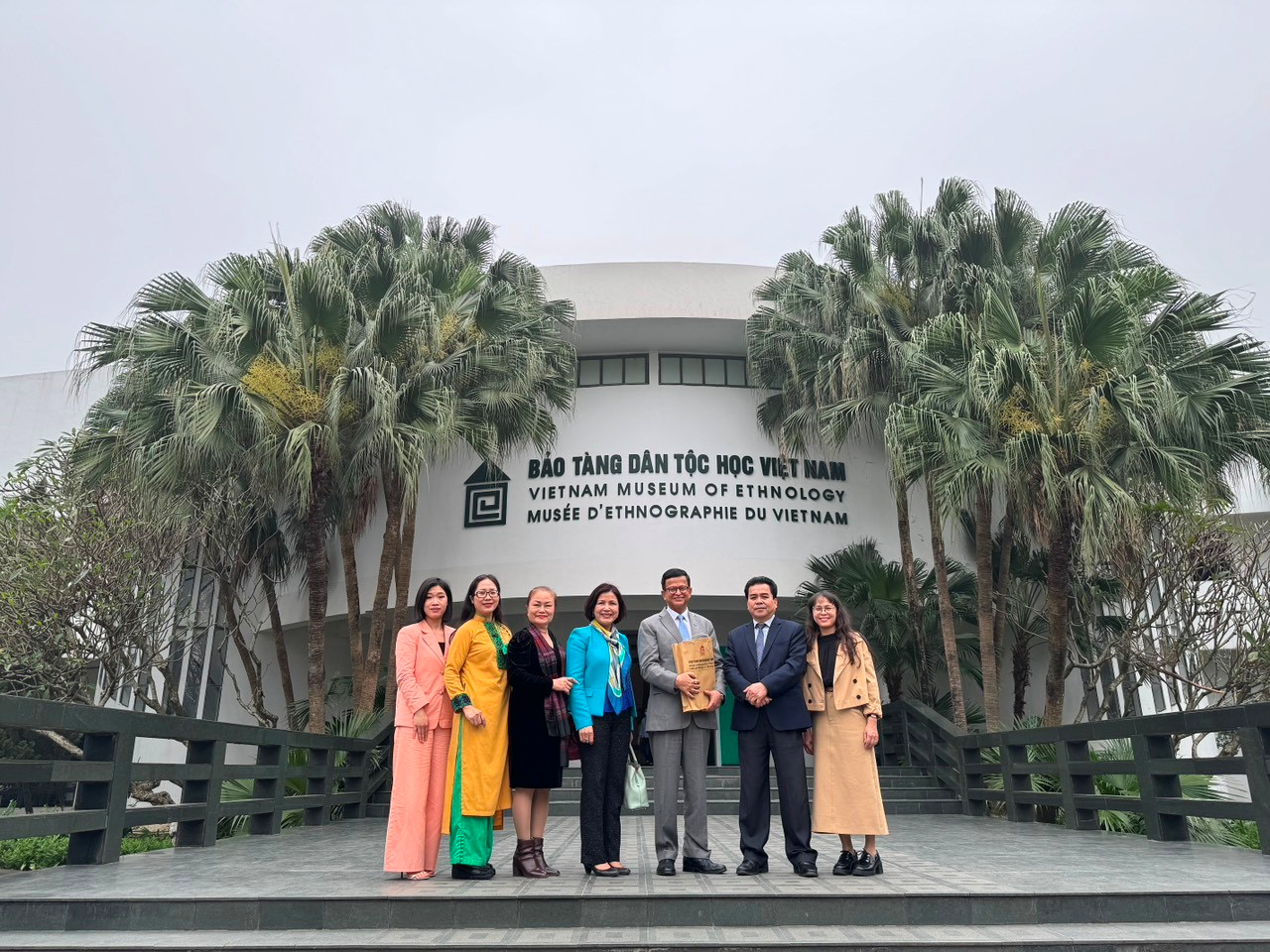
The two-floor building, which is inspired by the Vietnamese
famous and ancient bronze drum, holds the permanent collection.
A granite bridge leads from the main gate to the entrance of the
exhibition, creating a feeling of going up to a house-on-stilts
which is very popular in many areas of Vietnam. On entering the
Museum, the granite floor is decorated with dark tiles arranged
in the shape of an S. This decoration symbolises the shape of
the Vietnamese coastline, the earth is in dark colour and the
ocean is light grey.
The Vietnam Museum of Ethnology has been designed to reflect the
country's technical and scientific progress as well as the
Museum’s objectives. First of all, the Museum was created for
everybody. This is reflected in both the architecture and the
display techniques. The Museum has ramps for physically
challenged people and an electric elevator allowing access to
the second floor. All steps have handrails that are very
comfortable for older people. Learning from the experiences of
many museums in the world, the museum texts are not in capital
letters but small letters so that it is easy for people of
different ages to read them. Panels are presented at reasonable
heights, for both adults and children. In addition to objects,
there are photographs, texts, videos and many reference
materials, all of which can be brought into full play to inform
visitors with different levels of education and different needs.
The objects are displayed as centrepieces because they reflect
the everyday lives of the people. The Museum’s consistent point
of view is that the display should be simple, so that visitors
can admire the beauty and finesse of each ordinary and simple
item. Although there are no illustrative paintings in the
Museum, photographs and videos are used to illustrate people’s
lives.
A restricted number of 700 objects and 280 photographs are
displayed in the Museum’s permanent exhibits, which helps
visitors avoid being distracted by an over-representation of
artefacts.
The different collections are displayed according to language
groups and territories. Most of the objects presented in the 97
showcases are original. The showcases have either one-sided
windows or four-sided windows, depending on the artefacts
presented. For example, some cases present many artefacts;
others have only one significant object. Among the showcases in
the display, 50 cases are accompanied by texts. Each object has
a label denoting its name, the ethnic group and the place where
it was created. There are also mannequins, maps, graphs,
hardcover books, photographs, videotapes, cassette tapes,
models, and 33 section panels. Though the Museum is not large,
dioramas highlight certain customs or cultural features of
ethnic groups.
Adding to the many layers of information available to visitors,
the museum provides hundreds of panels composed of explanations,
illustrative photographs and maps. Unfortunately, because of
limited space, the texts are condensed. Not only do the texts
and the object labels serve a national audience, they are also
translated into English and French in order to facilitate
international visitors. Thus, visitors experiencing the museum,
even without a tour guide, are able to understand the main
messages of the displays.
New technical solutions have been used throughout the Museum,
such as focused lights. The light radiates inside and outside
the glass windows focusing on the most significant aspect of
each object in order to set off its beauty and draw visitors’
attention. In addition, a ventilation system has been installed
within each display area to protect the objects from mould and
decay.
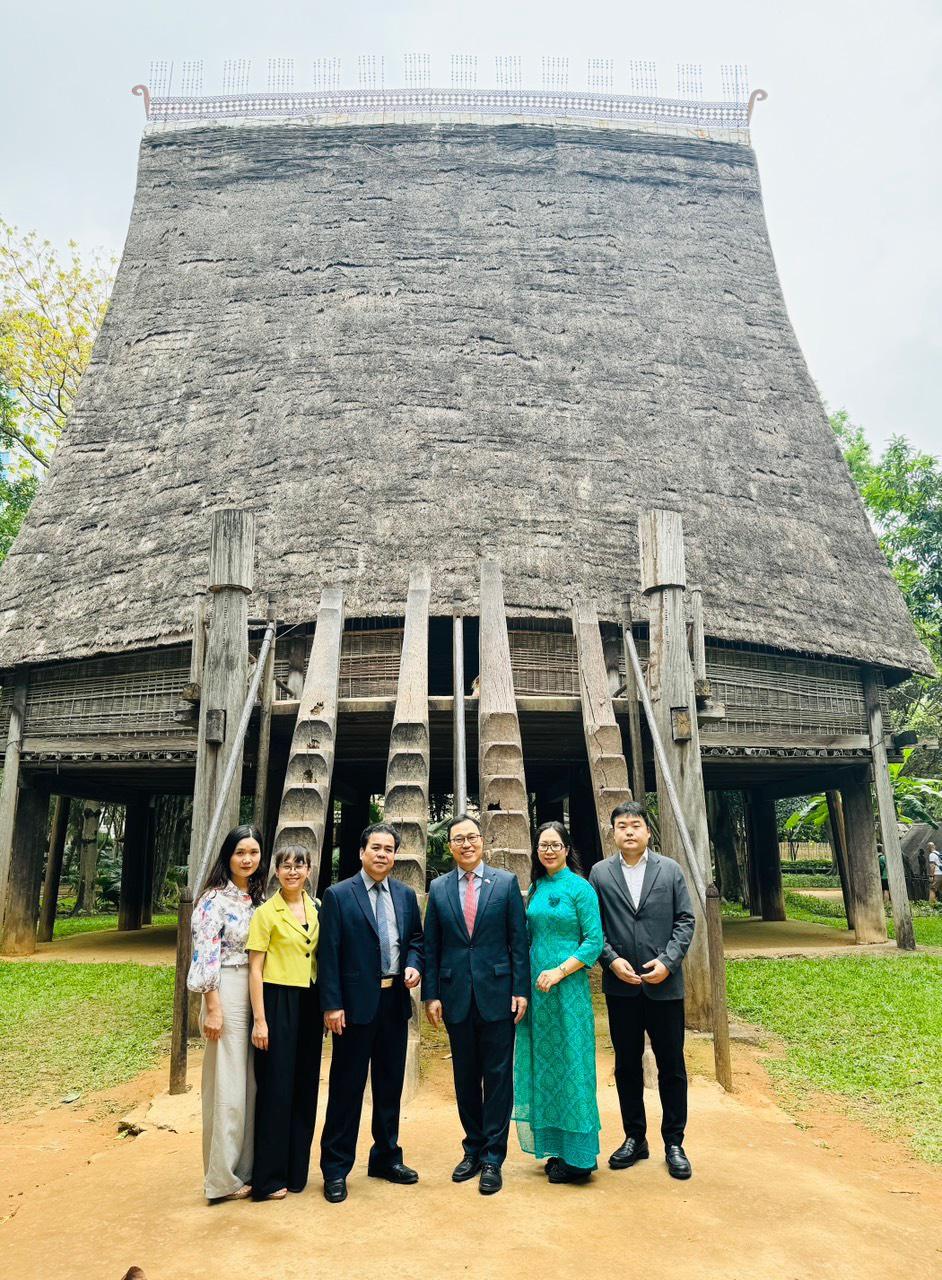
The outdoor exhibition area is only large enough for the most
popular architectural styles to be represented. Already
presented are the Ede long house, the Tay stilt house, the Yao
house half on stilts, half on earth, the Hmong house whose roof
is made of pomu wood, the Viet house with tile roof and the
Giarai tomb. There are future plans to present the Bahnar
communal house, the Cham traditional house and the Hanhi house
made with beaten walls. Between the houses, there are trees
indigenous to the area of each house, zigzagging paths and a
meandering stream crossed by small bridges. The outdoor museum
is being realised step by step.